
The Day Rome Lost Three Legions
The Battle of the Teutoburg Forest in 9 CE marked the moment the Roman Empire reached its northern limit. When three Roman legions were ambushed and destroyed in the forests of Germania, Rome abandoned any serious effort to conquer the region east of the Rhine, and never returned in force. For students, Teutoburg is more than a military disaster; it is a case study in how geography, leadership, and local resistance shape history and see the effects we are still living with today.
The Roman historian Velleius Paterculus, who personally served in the army, described the disaster in blunt terms:
“An army which in bravery, discipline, and experience had no equal was destroyed by the treachery of the enemy, the cruelty of fate, and the mistakes of its commander.”
For teachers, this moment immediately raises useful questions: How can a professional army collapse so completely? And what does that tell us about the limits of imperial power?
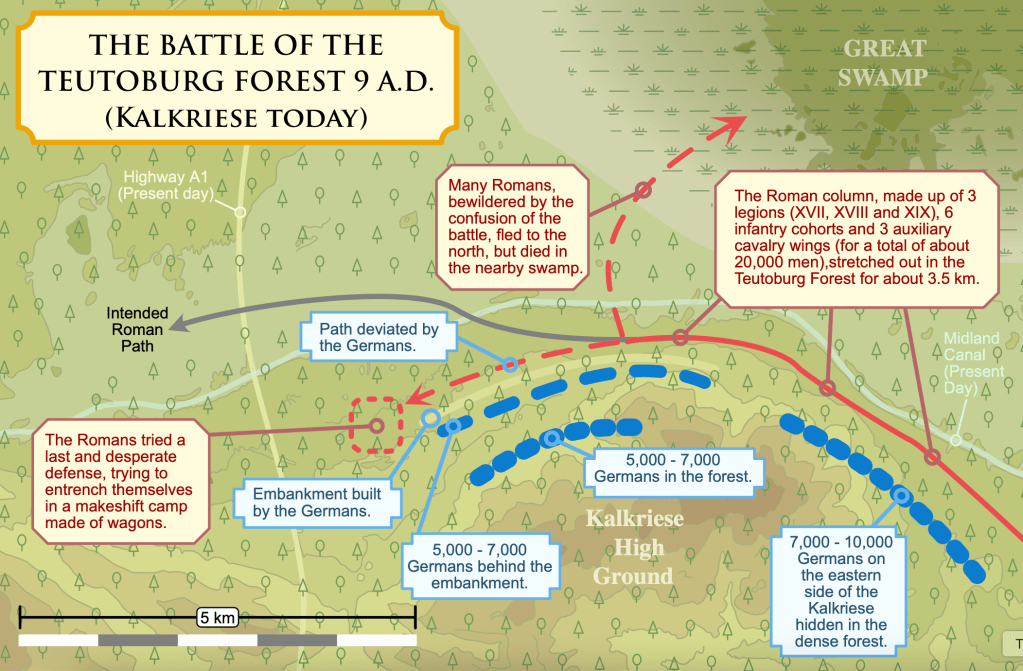
Geography: Rome’s Silent Enemy

Rome’s military success depended on open ground—roads, visibility, and tight formations. Germania offered none of these. Dense forests, muddy paths, constant rain, and narrow corridors turned Roman discipline into a liability. Soldiers marched in long columns with wagons, families, and supplies, unable to form their famous battle lines.
Cassius Dio emphasizes how environment shaped the outcome:
“The Romans were in great distress… for the forest was dense, the roads narrow, and the rain continuous.”
This is an ideal teaching moment. Students often assume stronger armies always win. Teutoburg shows how geography can erase technological and organizational advantages entirely.
Why the Romans Failed

The defeat was not just environmental. It was strategic and cultural. The Roman governor Publius Quinctilius Varus treated Germania as if it were already a peaceful province. He enforced Roman law, collected taxes, and dismissed warnings of rebellion. What he failed to grasp was that Germania was not politically unified, urbanized, or invested in Roman rule.
The mastermind behind the ambush was Arminius, a Germanic leader who had served as a Roman officer. He spoke Latin, understood Roman tactics, and knew exactly how Varus would respond to reports of unrest. Tacitus later noted the irony:
“Arminius, who had been faithful to Rome, turned Roman discipline against itself.”
For students, this highlights a critical historical theme: empires often fail not because they lack information, but because they misunderstand people.
The Aftermath: “Varus, Give Me Back My Legions”
News of the disaster stunned Rome. According to Suetonius, Emperor Augustus reacted with visible grief:

“He would dash his head against the doors and cry out, ‘Quintilius Varus, give me back my legions!’”
The emotional response mattered. Roman legions were not just military units. They were symbols of order and permanence. Losing three at once shattered the myth of Roman invincibility.
Rome did send forces back into Germania. Germanicus led brutal campaigns, recovered captured standards, and won several victories. Yet conquest stalled. Tacitus records the strategic decision that followed:
“Tiberius was of the opinion that the empire should be confined within its boundaries.”
The Rhine, which could be patrolled and fortified with forts, watchtowers, and roads, made a strong border than the Elbe River, which ran through dense forests and marshes, making it far harder for Rome to defend or supply an army.
Why Rome Never Tried Again
Teutoburg forced Rome to make a rare choice: restraint. Germania offered little in terms of cities, mines, or taxable agriculture, and occupying it required constant military presence. The cost outweighed the benefit. The Rhine became a permanent frontier, defended but not crossed. This is not to say that trade didn’t take place. Both sides benefited from the goods the other offered. No need for conquest.
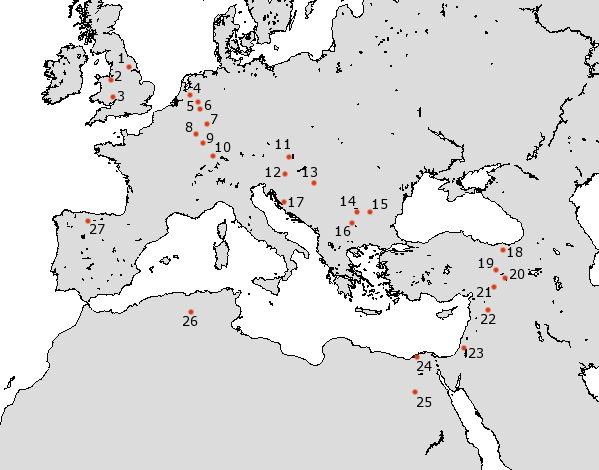
This decision shaped European history. West of the Rhine, Roman law, Latin languages, cities, and infrastructure took root. East of it, different political and cultural traditions developed. That divide still echoes today. One impact is the linguistic split seen in Belgium today. The area south of the Rhine speaks French, a Romance language; the area north speaks Flemish (a Dutch dialect), a Germanic language. For students, this is a powerful example of how ancient borders influence modern identities.
Teaching Implications and Classroom Connections
The Battle of the Teutoburg Forest works exceptionally well in secondary classrooms because it integrates multiple lenses:
- Geography explains military failure.
- Primary sources reveal Roman bias, blame, and trauma.
- Political history shows how empires decide when to stop expanding.
- Modern connections help students see why ancient history still matters.
Most importantly, Teutoburg reminds students that history is not just about who is strongest, but about who understands the land, the people, and the limits of power.
Rome survived the Teutoburg Forest. But it never forgot it. And it never crossed that forest again.
Recommended Resources
Battle of the Teutoburg Forest — Encyclopedia Brittanica
University of Georgia Classics Lists primary source excerpts with links — great for classroom source packets.
Classroom Resources (optional)
Ancient Rome Battles — Explore 10 key Roman battles and their historical impact through research activities.
Ryan Wagoner
The Lyceum of History
“I am indebted to my father for living, but to my teacher for living well.” — Alexander the Great
Follow me on: Blog | TpT | YouTube | X | Instagram | Facebook



Leave a Reply