Why the Battle of Salamis Still Matters
How can a single naval battle change the course of world history? The Battle of Salamis in 480 BCE offers secondary social studies teachers a powerful case study in strategic thinking, leadership, geography, and the impact of naval power. Fought during the Greco-Persian Wars, Salamis demonstrates how Athenian leadership under Themistocles, clever use of terrain, and disciplined naval tactics transformed a seemingly impossible situation into a decisive Greek victory.
The Persian Threat After Thermopylae
After the fall of Thermopylae and the burning of Athens, King Xerxes of Persia appeared unstoppable. His massive army occupied much of Greece, and his fleet, vastly larger than that of the Greek city-states, controlled the seas. Yet it was at sea, not on land, that the course of the war would turn. Themistocles, the Athenian statesman and naval strategist, understood that a direct confrontation in open waters would doom the smaller Greek fleet. Instead, he lured the Persian navy into the narrow straits between the island of Salamis and the Athenian mainland.
Geography and Naval Tactics at Salamis
The geography of the straits proved decisive. In the confined waters, the Persian fleet’s numerical advantage became a liability. Their larger, less coordinated ships struggled to maneuver, collided with one another, and lost formation. The Greek triremes, however, were lighter, faster, and crewed by well-trained rowers. They were able to ram Persian vessels with precision. This battle highlights a critical lesson students can analyze. Do more resources always guarantee success if strategy and environment are ignored?

Themistocles’ leadership was central to this outcome. He not only convinced skeptical Greek allies to fight at Salami, but also used deception to force Xerxes’ hand. He sent false messages, suggesting the Greeks were preparing to flee. Xerxes, eager for a decisive victory, ordered his fleet into the straits. The result was catastrophic for Persia. By day’s end, much of the Persian navy was destroyed or disabled. Xerxes was forced to retreat with the bulk of his army and leaving a smaller force behind that would later be defeated at Plataea.
Why Salamis Was a Turning Point
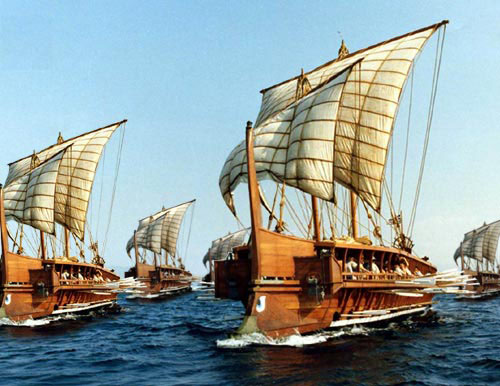
Salamis marked a turning point in the Persian Wars. It preserved Greek independence, ensured the survival of Athens, and allowed Greek political and cultural development to continue. Without Salamis, the foundations of classical Greek democracy, philosophy, and art, and their long-term influence on the Western world, might never have taken shape. This makes the battle especially valuable for classroom discussion about how military decisions can ripple across centuries.
Classroom Applications and Student Engagement
For students, Salamis invites active learning. Mapping the Aegean and tracing fleet movements helps visualize how geography shaped strategy. Diagramming trireme formations encourages spatial thinking and analysis. A “what would you do?” decision-making exercise—fight in open water or retreat into narrow straits—forces students to weigh risk, leadership, and environmental constraints. Finally, Salamis opens discussion on naval power versus land power, a theme that remains relevant in modern geopolitics.
The Battle of Salamis reminds us that history is not just shaped by size and strength, but by insight, preparation, and the intelligent use of place. Few lessons translate more clearly from the ancient world to the modern classroom.
Recommended Reading
The Battle of Salamis – World History Encyclopedia (comprehensive overview)
The Greek Strategy at the Battle of Salamis (480 BCE) – World History Encyclopedia
Recommended Resources
Greco-Persian Wars Reader’s Theater — Script + Fluency & Discussion Questions
Ryan Wagoner
The Lyceum of History
“I am indebted to my father for living, but to my teacher for living well.” — Alexander the Great
Follow me on: Blog | TpT | YouTube | X | Instagram | Facebook



 Lyceum of History
Leave a comment